


He's Alive. I Lost Him Anyway.
- Jan 18
- 24 min read
I need to tell you something I've been avoiding for years.
I couldn't save my twin brother.
And I don't know if that's because I failed him, or because God gave me something He didn't give him, or because my brother had what he needed and just couldn't use it.
I don't know. And not knowing is eating me alive.
I'm a twin. Two minutes older than my brother.
And for most of my life, those two minutes felt like a lifetime of responsibility.
They say twins have this special bond. This unbreakable connection. Like you're two halves of the same whole, formed together, born together, meant to walk through life together.
But what they don't tell you is what happens when trauma splits you down the middle. When one of you survives and the other one gets stuck. When you spend your entire childhood being told you're supposed to stay together, protect each other, be each other's person, and then you wake up one day and realize you're standing on opposite sides of a chasm you can't cross.
My first real memories of life are chaos.
Not the kind of chaos that comes from a busy household or too many kids running around. I'm talking about the kind of chaos that leaves scars you can feel in your bones before you have the language to name them.
I have flashes. Fragments of memories that don't quite form a complete picture but are vivid enough to turn my stomach even now. An unsafe home. People I didn't know coming in and out. Men. Women. Faces I can't remember but energy I'll never forget. The feeling of being scared all the time. Of not knowing where safety was or if it even existed.
The police coming. People being arrested. My grandmother being told she'd be next.
These are my first memories.
I remember living on East Main Street in Bridgeport, Connecticut. Not far from Father Panik Village, which was the projects back then. There was a small Puerto Rican bodega diagonal across the street from our apartment. And I remember me and my brother, our, maybe five years old, running across that busy street.
We were so small. Too small to be crossing a street like that by ourselves. But there we were, holding hands, dodging cars, running to that bodega like it was the only place in the world that made sense.
The smell hit you the moment you walked in. Traditional Spanish seasonings. Sazón. Adobo. The kind of smell that wraps around you and makes you feel like someone's cooking something good even if no one is. They always had the best music playing. Salsa, merengue, bachata. Music that made the whole place feel alive even when everything else in my world felt dead.
And the owner. I can still see his face. The way he'd look at us when we walked in. There was sadness in his eyes. Deep sadness. The kind that comes from knowing something's wrong but not knowing how to fix it.
Back then, I think there was more community. More people willing to help raise your kids quietly instead of calling the authorities or reporting things to DCF. Even when they knew the situation wasn't the greatest, they just took a little more care in helping however they could.
And while we were little and probably didn't have the words to really explain what was happening in our home, he knew. He had an idea. I'm sure of it.
So he'd hand me that broom. And I'd sweep every corner of that little store like my life depended on it. Like if I did a good enough job, maybe he'd keep letting us come back. Maybe he'd keep feeding us.
And when I was done, he'd give us peanut butter and jelly. Sometimes a can of ravioli. He'd hand it to me with this look on his face that I didn't understand then but I understand now. It was pity. And helplessness. And love. All mixed together.
And we'd run back across that street, me holding the food, my brother holding my hand, and I'd make our little meal. I'd open the can. I'd spread the peanut butter. I'd make sure my brother ate first.
That's how we survived sometimes.
Those are my first memories. Not of playing. Not of being loved by the people who were supposed to love us. But of me taking care of my brother when I was barely old enough to take care of myself.
I didn't know where the adults were. I just knew they weren't with us.
And then came the day that changed everything.
My uncle, my mother's only brother, took us to a routine doctor's appointment. Him and his girlfriend. I don't remember much about the appointment itself. But I remember the moment I told the truth.
I told the doctor what was happening to me. That I was being touched. That I was being made to do things.
And that's when everything unraveled.
They tested me for sexually transmitted diseases. I tested positive. The police were called. DCF, Department of Children and Families, was called. We were removed from our home and placed in a hospital for further testing. Malnourished. Traumatized. Broken in ways I didn't even understand yet.
And then we were placed in a foster home.
Through all of that, my brother stopped talking. He just shut down completely. He would only whisper things in my ear, and I became his voice. I took care of him. I made sure he was okay. I became the buffer between him and a world that felt too big and too scary for both of us.
The word for it is "parentified." I was parentified at a very young age. Which is just a clinical way of saying I became a parent to my sibling when I was still a child myself.
And for me, it wasn't a choice. It was just who I was.
Taking care of my brother was as natural to me as breathing. It was my job. My purpose. The thing that made me feel like I mattered.
When we got adopted, I was still protecting him. I had a very hard time letting our foster parents, and eventually our adoptive parents, actually be parents. Because I felt like nobody could take care of him the way I could. Nobody understood him the way I did. Nobody loved him the way I loved him.
I was his protector. His voice. His shield.
He used to stutter when we were kids. People would make fun of him. Mock the way he talked. Laugh at him when he tried to get his words out.
So I became his voice. Not just because of the trauma we'd been through, but because he was embarrassed to use his own. He was afraid of being laughed at. Afraid of sounding stupid. Afraid of the world seeing him struggle.
So I spoke for him. I defended him. I made sure everyone knew he mattered.
I was also really smart in school. School came easy to me in a way it didn't for a lot of other kids. I loved to read. I understood things quickly. I was good at it.
My brother struggled. School was hard for him. He didn't pick things up the way I did.
I remember in elementary school, my teachers pulled my parents aside and suggested I skip a grade. They said I was advanced. That I'd be bored if I stayed where I was. That I needed more of a challenge.
My parents said no.
They said we were twins. That we should stay together.
And I think in that moment, looking back on it now with the clarity that only comes from years of distance, it solidified something in my mind.
It told me that my role was to stay with my brother. That my own growth, my own potential, my own advancement didn't matter as much as keeping us together. That I was supposed to sacrifice for him.
That's just what you do when you're a twin.
Being a teenager was complicated for both of us. But in very different ways.
I tried to be perfect. Or as close to perfect as I could get. I did well in school. I did my chores. I tried to be respectful, obedient, the kind of kid my parents could be proud of. Not because I naturally wanted to be perfect, but because I was terrified. Terrified of being sent back. Terrified of doing something wrong. Terrified of not being enough.

My parents were very strict. We were always in church. We weren't allowed to do a lot of the things other kids our age were doing.
But during that time, something else was happening that would change everything for me.
My birth mom ended up in prison. And somehow, by what felt like divine orchestration, she ended up in the same prison as my adopted aunt, my adopted mom's sister.
They started talking. My birth mom mentioned the twins she'd given up. My adopted aunt realized those twins had been placed with her sister.
Eventually, my adopted mom allowed us to go to the prison to meet our birth mom.
And that's where my identity fractured.
Because suddenly, I had this person in front of me who looked like me. Who shared my features. My skin. My eyes. And I was so hungry for that connection. So desperate to feel like I belonged somewhere. Like I came from something.
I became obsessed. I thought about it constantly. How do I get back to her? How do I get to live with my family? How do I build a relationship with these people who share my blood?
It became everything to me. An idol, really. Though I didn't see it that way at the time.
My brother didn't seem to care. He went to visits, sure. But he didn't talk much. He wasn't engaged. He didn't show the same hunger I had to know where we came from.
And I couldn't understand it. How could he not want this? How could he not need this the way I needed it?
When I was 15, I ran away.
I left my adopted family and went to stay with my biological family. It was the summer before my sophomore year of high school. I didn't tell anyone. I just went.
I thought I'd finally feel it when I got there. The love. The connection. The sense of belonging I'd been searching for my whole life. I thought I'd look at these people and see myself reflected back. I thought
I'd finally understand who I was.
When the summer ended, I came back to my adopted family's home.
And that's when they told me.
My brother had been arrested. He was in jail. And he'd be there for at least the next 7 to 10 years.
The floor dropped out from under me.
I couldn't breathe. I couldn't think. I couldn't process what they were telling me.
This was the first time in our entire lives that we were going to be truly separated. The first time I wouldn't be there to protect him. The first time I wouldn't know if he was okay.
And all I could think about was him in there. In jail. At 15 years old.
I was terrified for his safety. Because I knew what people said about jail. The stories. The violence. The things that happen to people in there, especially young people who don't know how to protect themselves.
And I knew my brother. I knew he wasn't really 15. Not mentally. Not emotionally. I knew he still stuttered. I knew he struggled to speak up for himself. I knew he was vulnerable in ways that terrified me.
I was scared my brother was gonna die in jail. And I think sometimes, even now, I'm still scared he's gonna die in jail.
I was also angry. Angry that my adopted family had waited until I came back at the end of the summer to tell me. Why didn't they call me? Why didn't they find a way to let me know?
And I was angry at my parents. Because I felt like they just gave up on him. Like they were so embarrassed that he was in jail that they stopped fighting for him. Stopped showing up for him. Stopped believing in him.
And that made me even more determined to be there for him. Because if they weren't going to show up, I would.
But I was also drowning in fear. Fear for what he was thinking. What he was feeling. Fear that I couldn't control the outcome. And I've always been such a control person. I've always needed to know I could fix things, manage things, make things better.
And this was completely out of my control.
So I did what I always did. I found a way to take care of him.
I got a babysitting job. I wasn't old enough for a real job yet, but I could babysit. And I used every dollar I made to send him commissary. So he'd have what he needed while he was locked up. So he'd know someone was thinking about him. So he'd know he wasn't alone.
I sent him pictures. I sent him letters. Long letters filled with updates about life on the outside, scripture, encouragement, love.
But I never visited him.
I couldn't.
I couldn't bring myself to see him in an orange jumpsuit. I couldn't watch him walk into a room in handcuffs. I couldn't sit across from him with a guard watching and a time limit ticking and a barrier between us.
I couldn't see my brother like that.
So I overcompensated. I sent more pictures. More money. More letters. As if the volume of my love could make up for the fact that I couldn't show up in person.
And maybe I was also protecting myself. Because if I didn't see him in there, I could pretend it wasn't real. I could pretend he was just... away. Not locked up. Not caged. Not suffering.
He came home when we were 21. The week before I got married, actually.
And I thought that would be it. I thought he'd be done. That he'd learned his lesson. That he'd never go back.
But over the years, he did. Back and forth. Back and forth.
Even to this day.
And every single time, I showed up. Not in person. But in the ways I knew how.
I took the calls. My husband and I sent money. I wrote letters. Did all the things I felt like I was supposed to do.
Not just as his sister. But as the person who'd been taking care of him since I was four years old.
And then, years later, when I had my own son, something happened that I didn't expect.
I started to fear the number 15.
My firstborn child. My only son. The first person I ever loved who was mine to protect.
And as he got older, as he approached his teenage years, I found myself paralyzed with fear.
Because 15 was the age I lost my brother. 15 was the age that ripped him away from me and our childhood as we knew it. 15 was the age that marked the beginning of a cycle I couldn't stop.
And I was terrified that 15 would do the same thing to my son.
I became obsessed with keeping him safe. With making sure he didn't make the same choices my brother made. With controlling every aspect of his life so I could guarantee he wouldn't end up behind bars.
I didn't let him leave the house. I stayed on top of his every move. I tried to instill the fear of me in him because I didn't fully trust God to keep him safe.
I parented out of fear. The same way I'd been protecting my brother out of fear my whole life.
And all my son wanted was for me to lay in the bed with him. To let his head rest on my chest. To make music with our breathing in silence. To just be his mom without the weight of all that terror.
But I couldn't. Because I was too busy trying to save him from a fate I couldn't control.

My son is 23 now. He made it past 15. He's not like my brother. He's his own person with his own story.
But I spent years trying to mold him into proof that I could save someone. That I wasn't a failure. That if I just controlled things enough, I could keep the people I love from falling apart.
And in doing that, I almost missed him. The real him. Just like I've been missing my brother for years.
Eventually, my brother came home again. And this time, he started building relationships with our biological family. The same family I had distanced myself from because I realized the life they were living wasn't the life I wanted to create for myself.
But he fit in with them. He chose their lifestyle. The same lifestyle our biological mother had lived. In and out of jail. Street life. Chaos.
And I couldn't understand it.
I wanted more for him. I tried to help him. I tried to get him into mental health programs. I tried to help him get on the straight and narrow.
But he wouldn't follow through. He didn't want that kind of help.
And we started fighting. He'd tell me I thought I was better than him. He'd say someone needed to knock me off my high horse. He'd throw my success in my face like it was an insult.
And it hurt. It hurt so much.
Because I felt like I'd given everything to make sure he was okay. And now he was turning on me.
But the story really shifts in 2020.
I'd been searching for our biological father for years. I didn't know anything about my father's side of the family. But I knew that if anyone knew who he was, it would be my mother's brother, my uncle Jesse.
By the grace of God, in the middle of COVID, I found him. My god-sister and I hopped on a flight to North Carolina, where he was living on dialysis.

When we walked into his apartment, the first thing I noticed was the walls. They definitely looked like they needed a good scrub and a repaint. But they were covered, absolutely covered, with memories.
Pictures everywhere. Pictures of my biological mom. My biological grandmother. My uncle at different stages of his life.
And pictures of my brother.
Pictures of him as a baby. As a toddler. Christmas pictures. Pictures of him riding a bike outside. Pictures of him smiling.
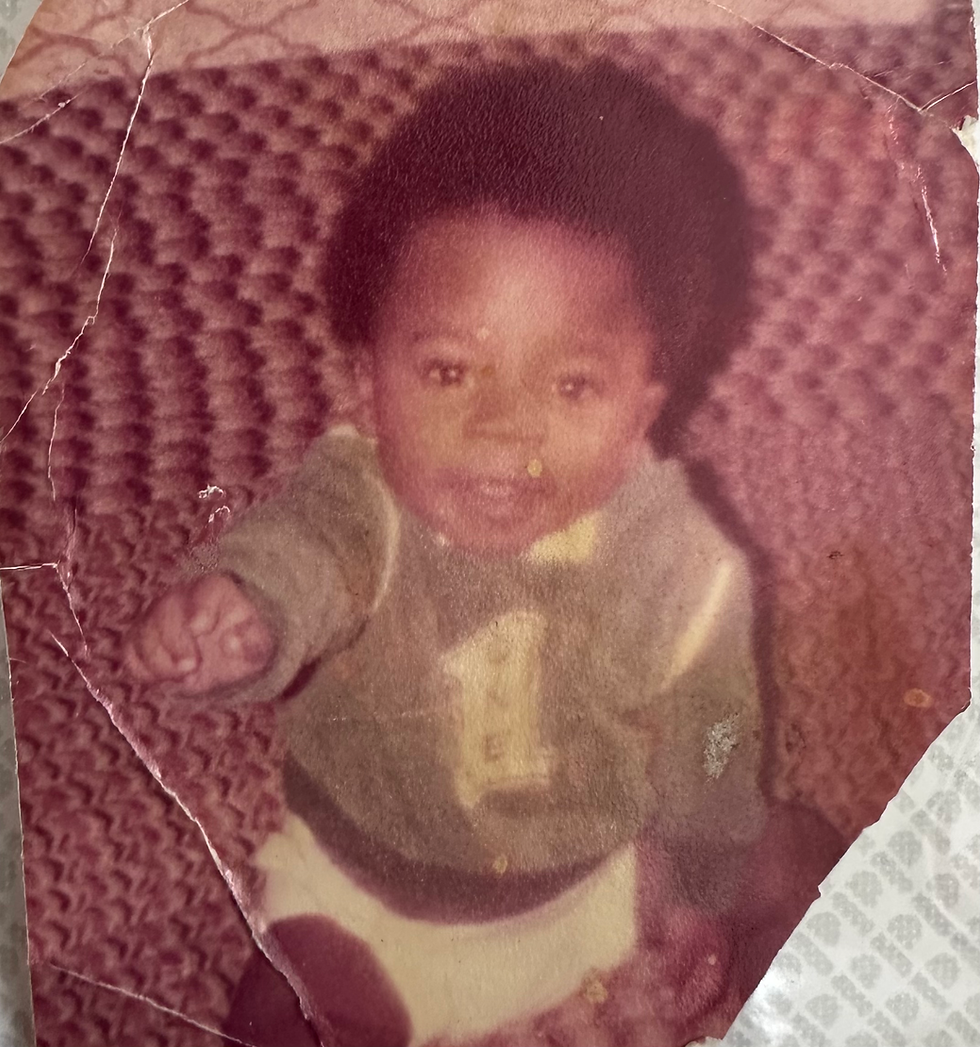
There was a feeling of excitement when I saw those pictures. Seeing people in my family. Seeing their faces. Their memories. Their smiles and happiness frozen in time on those walls.
But it also hurt.
Because I wasn't in any of them.
I wasn't part of those times. I wasn't part of those memories. I wasn't part of that happiness.
I stood there staring at those walls, and something inside me cracked open.
I asked him. "Where are the pictures of me?"
And that's when he told me.
He sat down. And I could see the weight of what he was about to say settle over him like a heavy coat he'd been carrying for decades.
He told me that when we were very young, my mother and my grandmother were trafficking me. They were allowing men to come into the house. I was being abused in ways I'm still processing. That's how I contracted that sexually transmitted disease.
My uncle knew. He said he did his best to try to get my mom and my grandmother to let us come live with him and his girlfriend. He begged them. He pleaded with them. He tried everything he could think of.
They refused to let me go.
But they let my brother go.
So the reason there were all these pictures, Christmas, bike rides, all these moments of normal childhood, was because my brother primarily lived with my uncle during that time.
He wasn't experiencing what I was experiencing.
He wasn't enduring the abuse I was enduring.
He was protected.
And then my uncle said something that broke me even more.
He told me he carried a deep level of guilt. That he never had biological children of his own after we were taken because he felt so much guilt for what happened to us. Specifically, for what he wasn't able to save me from.
He told me that my mom didn't want to treat me the way I was being treated. That she had experienced the same abuse as a child. But she wasn't strong enough to stand against my grandmother.
My grandmother was the mastermind.
And my mother was too broken to fight her.
When he said that, I felt like the air had been sucked out of the room.
I sat there trying to process what he'd just told me. Trying to make sense of it.
I felt cheated. I felt unloved. I felt invisible. Like I didn't matter enough to be protected. Like I didn't matter enough to be photographed.
And even now, years later, I still feel that sometimes. I'll look into the eyes of my grandchildren, who are one and two years old, and I wonder what I looked like at their age. I can't look at them and see myself reflected back. I can't say, "Oh, you look just like I did when I was a baby."
Because there are no pictures of me before a certain age. That part of my life just... doesn't exist.
And because I'm such a storyteller, it's hard to paint the picture of a story I can't even see for myself. There's this massive missing piece of my life. And I'll never get it back.
But here's the part that's been haunting me ever since that day in North Carolina.
If my brother was protected from the worst of the abuse, if he was living with our uncle while I was being trafficked, then why is he the one who's spent more of his life in prison than out in the world?
Why am I the one who broke the cycle, and he's the one still stuck in it?
Did God give me something He didn't give my brother?
Or did He give us both the tools, and I'm just the one who used them?
I don't know.
And not knowing is what used to keep me up at night.
Because if God gave us both the same tools and my brother just couldn't use them, then it's not my fault I couldn't save him.
But if God gave me something He didn't give my brother, some strength, some resilience, some ability to overcome, then why? Why me and not him?
We came into this world together. Two minutes apart. We endured the same removal. The same foster care. The same adoption.
But we didn't get the same outcome.
And I've spent my whole life trying to figure out if that's because I did something right, or because he did something wrong, or because God chose me and not him.
In April 2020, I wrote my brother a letter. He was in prison again. And I was tired.
I told him I was tired of being in this place with him every time he made choices that led him back to prison. I told him that since we were children, I'd been his protector. That even at four years old, when I didn't know how to take care of myself, I was trying to be the best big sister I could be.
I told him I didn't fully understand everything that happened when we were teenagers. That I was selfish and self-absorbed, searching for our birth family because it was something I needed. That I never considered the fact that in finding me, I was losing him.
I told him that when I came back that summer and found out he was gone, it broke me. That I wouldn't see him, the one person who came into the world WITH me, for years.
I told him I was tired. That everyone was tired.
I told him he was 37 years old. Too old to keep going down this path. That I couldn't figure out why he kept putting himself in this position.
I told him there were so many people who loved him and wanted the best for him, but it meant nothing if he didn't love and want the best for himself.
I told him he needed to seek God. To be honest with himself about his mental health. That he'd endured trauma just like I had, but we dealt with it differently. That he'd probably endured even more, considering what he'd experienced in prison.
I told him he needed help. That if he didn't get it, I feared I'd be burying him sooner than later.
And then I told him I loved him more than anyone in this world. Except for God, of course.
I signed the letter. I included scripture. Verses about strength and comfort and God's promises. I sent it.
And nothing changed.
He came home again. And this time, I really thought it would be different.
This was post-COVID. The world was operating differently. I thought maybe he'd finally get it. That he'd want to live differently.
So I prepped everything. I made sure he had a bed at my house. I lined things up to help him get diagnosed and get the services he needed. I really believed this time would be different.
And then one day, he came to my office.
He walked in. And he got in my face.
His voice was angry. Sharp. Cutting. But I could still hear it, that hint of stutter underneath the anger.
The same stutter he'd had as a kid. The one people used to mock him for.
And hearing it made me feel bad. It softened me for a moment. Gave me a little more grace.
I could tell he was holding back tears. That underneath all that anger was pain. Frustration. Hurt.
He started yelling. Telling me what a bad sister I was. That I'd never been there for him. That I didn't care about him. That I thought I was better than him.
And then he started telling other people a version of the story that wasn't true. A version where I was the villain. Where I was the one who abandoned him. Where I was the reason he kept ending up in prison.
I sat there, stunned.
After everything. After all the years. After all the letters and the money and the phone calls and the commissary.
He looked me in the face and told me I was a bad sister.
As if all the years he'd been in prison, and all the years I'd suffered and sacrificed for him, didn't exist.
And I wanted to stand up and slap him. I wanted to punch him dead in his face.
Because I felt disrespected. And a part of me was angry that, again, I had to be the bigger person. Again, I had to take the abuse.
But I didn't.
Because I reminded myself that the person standing in front of me saying all this was saying it from a place of hurt and trauma. That he didn't have the language to really express what he was feeling. That he probably knew, deep down, that what he was saying wasn't true. But he needed someone to be angry at.

And I was going to be the sounding board for that anger.
Because he doesn't know better, but I know better.
And so I had to eat it. I had to swallow my anger and my hurt and my desire to defend myself.
Because that's what I've always done.
But here's what I also know: there's a part of him that's jealous of me.
And I can't fix that. I can't make him see that I didn't get some special gift he didn't get. I can't make him understand that I didn't choose to break the cycle and leave him behind.
I just... did.
When he went to prison again last year, I had to make a decision.
I told him I wasn't willing to do this sentence with him. That I couldn't keep showing up the same way I always had.
My intention was to help with nothing at all. To completely step back. To let him figure it out on his own.
But I still find myself and my husband sending him money when we can. Because we know he doesn't have anyone else who's going to do it.
But I haven't written any letters this time. Not one.
And I still can't bring myself to visit him. I never have. Not once in all these years.
Because I can't see him like that. I can't watch him shuffle into a room in handcuffs. I can't sit across from him with guards watching and time limits ticking and barriers between us.
I can't see my brother caged.
So I send money. And that's it.
And even that feels like too much sometimes. And not enough at the same time.
And I think that's when I finally had to face the truth I'd been avoiding my whole life.
I couldn't save my twin.
Not because I didn't try hard enough. Not because I didn't love him enough. Not because I failed him.
But because saving him was never my job.
I don't just feel sad about my brother. I grieve him.
I grieve the story I thought we'd tell together. The twin story. The "we both survived and we both thrived" story. The generational curse-breaking duo who walked out of foster care hand in hand and built beautiful lives.
But he didn't follow me out.
And that makes me feel like a failure. Not just as a sister, but as the person out here trying to help kids in foster care overcome their circumstances.
How can I tell other people's kids they can make it when my own brother, my twin, the person I came into this world with, is still stuck?
I'm angry at him for wasting what I fought so hard to give him. For coming to my office and getting in my face after I prepped the bed and lined up the services and believed THIS time would be different.
But I also feel guilty for being angry.
Because I know he's not okay. I know he has undiagnosed mental health issues. I know prison has traumatized him in ways I can't even fathom.
I know that even though my brother is 43 years old, mentally, he's still 19.
And I have nights where I cry for my brother. Because I can't help him. Because I don't have the skills or the tools to help the person I shared a womb with.
And I'm left with this question I can't answer...
Why did God protect me enough to break the cycle, but not him?
There are parts of me that feel relieved he didn't endure the abuse I endured. Because I don't know if he was strong enough to survive it.
But there are also parts of me that feel angry and embarrassed about the choices he's made. About the way he's chosen to live.
And there are parts of me that are just deeply, deeply sad.
Because my brother has spent more of his life in prison than out in the world.
And I don't know what trauma he's experienced in there. I don't know what's been done to him. What he's seen. What he's had to become in order to survive.
And it breaks my heart.
It's still something I struggle with. Learning how to let go. How to put up boundaries. Even putting up those boundaries has been hard.
Because for so long, taking care of him has been my identity. My purpose. The thing that made me feel like I mattered.
And letting that go feels like losing a part of myself.
But here's the truth I'm finally starting to see...
I made my brother's healing my responsibility. And it was never mine to carry.
God didn't choose me to break generational curses FOR my brother.
He chose me to break them THROUGH my own story.
My brother has his own story. His own journey. His own relationship with God.
And I am not responsible for that.
The scripture says, "Come to me, all you who are weary and burdened, and I will give you rest. For my yoke is easy and my burden is light" (Matthew 11:28-30).
But I've been carrying a yoke that was never mine. A burden God never asked me to pick up.
I spent my whole life being defined as his protector. As his voice. As his savior.
But I was never meant to save him.
I was meant to save myself.
And maybe that's the hardest truth of all.
Because if I admit I can't save him, then I have to admit that maybe I never could. That maybe all those years of fighting for him and speaking for him and sacrificing for him didn't change the outcome.
But that's not true either.
Because here's what I know...
God used my story. He used my willingness to speak up at that doctor's appointment when I was just a little girl. He used my obedience. He used my decision to break the cycle.
He used me to show foster youth that there's a way out. That you don't have to repeat the patterns. That you can overcome.
But my brother's freedom? His healing? His choices?
That's between him and God.
Not me.
And if I don't let go of the responsibility I've been carrying, it will destroy me.
Because you can't save someone who doesn't want to be saved. You can't carry someone who won't walk. You can't love someone into freedom if they're determined to stay in bondage.
And holding onto that responsibility, that weight, doesn't help him. It just keeps me stuck too.
So here's what I want to say to the people reading this who see themselves in my story...
To the siblings who've been carrying their brothers and sisters since childhood:
You can love them. You can support them from a distance. You can pray for them. But their healing is not your responsibility. You were never meant to be their savior. You were meant to be their sibling. And sometimes, that means letting go of the weight you've been carrying and trusting God with the outcome.
To the people who broke the cycle while others in their family stayed stuck:
It's not your fault. You didn't get some special gift they didn't get. You're not better than them. You're just on a different path. And their path is theirs to walk. You can't walk it for them. No matter how much you love them.
To the people asking "Why me?" Why did I make it out and they didn't?:
I don't know. I wish I had an answer. But what I do know is that your survival is not a betrayal of their struggle. Your healing is not a rejection of their pain. You are allowed to break free even if they don't. You are allowed to thrive even if they're still stuck. And you are allowed to release the guilt of being the one who made it out.
To the parents who've been parenting out of fear because of what happened to someone you love:
Your children are not the people you lost. They're not the siblings who got stuck. They're not the family members who didn't make it out. They're their own people with their own stories. And they need you to see them for who they are, not who you're afraid they'll become.
I don't know if my brother will ever break free.
I don't know if he'll ever get the help he needs. If he'll ever stop going back to prison. If he'll ever see himself the way I see him.
But I know this...
I can't save him. And that's not my failure.
God knew me before He formed me in my mother's womb (Jeremiah 1:5). He knew what I would endure. He knew what my brother would endure. He knew we'd walk different paths.
And He chose me for mine.
Not because I'm stronger. Not because I'm better. But because this is the story He gave me.
And my job is to steward it well. To point people back to Him through it. To show foster youth that there's hope even when the world says there isn't.
My brother's story is his. And I have to trust that God loves him just as much as He loves me. That He's working in my brother's life in ways I can't see. That He hasn't forgotten him.
Even if I can't save him.
So if you're reading this and you've been carrying someone else's healing as your responsibility, hear me:
You can release it.
You can love them and release them at the same time.
You can grieve the story you thought you'd tell together while still living your own story fully.
You can be the one who breaks the cycle even if they don't follow you out.
You can parent out of love instead of fear.
And you can trust that God loves them just as much as He loves you.
Even when you can't save them.
Because the truth is, you were never supposed to.
Be encouraged in these Unashamed Streets - Sana


Comments